
The Ifield Occupational Therapy team consists of
- Level 1 Sensory Integration trained Occupational Therapist (0.4 FTE)
- 1 Occupational Therapy Assistant (OTA) - full time
Occupational Therapy focuses on developing independence in daily living skills. These are called occupations and include self-care, school and play. The main areas include:
-Fine motor skills
-Gross motor skills
-Self-care skills
Sensory processing differences
“Occupational Therapists can help children and young people develop the skills and confidence to grow, achieve and enjoy everyday life at school” (Royal College of Occupational Therapists).
Ifield School employs an Occupational Therapist for two days per week, and a full time Occupational Therapy Assistant. Occupational Therapy goals are usually focused on motor skills and sensory regulation. These therapy goals are embedded into the curriculum and there are multiple opportunities to work on them, across the school day.
A key element of Ifield School’s OT support is training staff so that they have the underpinning knowledge, techniques and strategies to better support pupils. This enables pupils to utilise techniques, generalise skills and make the most progress, supporting life long independence in daily living skills.
Teaching staff regularly arrange meetings with the Occupational Therapy team to review progress towards EHCP outcomes and set new targets, including any proposed updates to the provision plans including additional interventions and strategies.
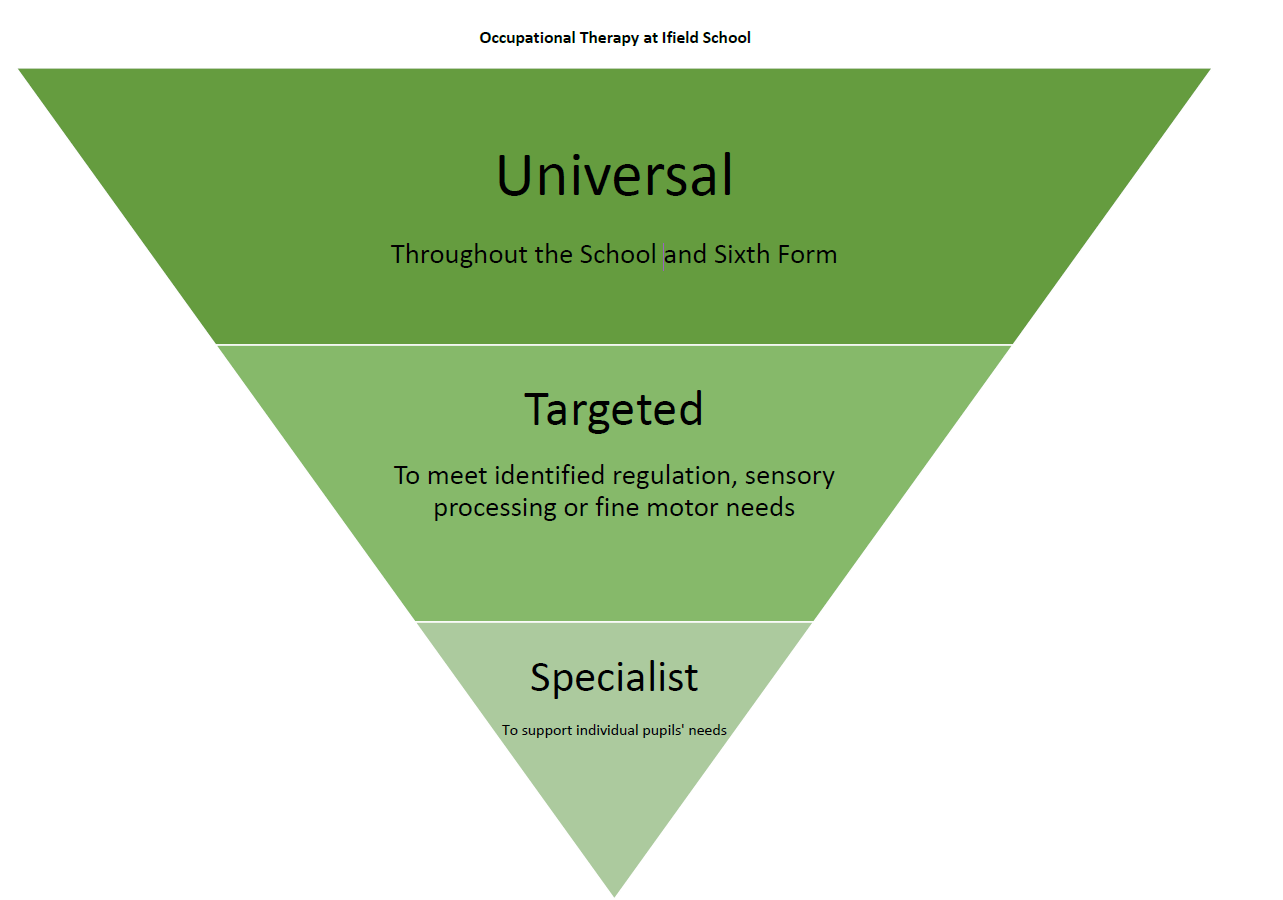
Universal interventions available to all pupils
•Ifield School’s Occupational Therapist is Sensory Integration trained (Level 1).
•There is no referral process, any pupil can access interventions recommended by the Occupational Therapist.
•Whole-school, universal approaches include training and resources that help every pupil by:
- Promoting and developing co/ mutual regulation and self-regulation
- Ensuring staff understand and support the participation, wellbeing and development of pupils
- Promoting engagement in learning, by ensuring sensory needs are recognised and met
- Staff training as part of the induction process, Teacher Meetings, Bitesize Trainings and Staff Development Days
- Promoting opportunities for gross and fine motor development as part of the curriculum
Developing sensory areas within the classroom; including, access to balance equipment, trampolines and spinning disc chairs.
•Movement breaks are encouraged across all curriculum pathways.
•Parent Workshops are delivered termly to support families on a range of OT topics including Sensory Regulation Strategies at home including;
-Introduction To Sensory Processing
-Introduction to Sensory Diets
-Sensory Circuits
-Proprioception and Vestibular
-Interoception
-Sensory Feeding Difficulties.
Targeted interventions and approaches delivered by the Occupational Therapy Team or by Class Teams
• OT-led staff training for example, Sensory Regulation Approaches such as Swing Room Training, enables staff to understand and support the participation, wellbeing and development of individuals and groups of pupils with identified needs.
• Programmes developed and overseen by an Occupational Therapist, for example handwriting programmes, Sensory Circuits or Motor Skills Groups.
• Advice to help school staff personalise activities, equipment and environments to help individuals and groups take part and achieve in the classroom, on the playground, in PE and elsewhere.
• Support with developing daily living skills, including, toileting, dressing and eating.
• Sensory Diets that can include
- Sensory Circuits
- Swing Room sessions
- Sensory Equipment, for example, a Hug Vest, Weighted Jacket or a Chewie.
- Quickshifts Music, more information available For Parents - Vital Links
- Therapeutic Brushing and Joint Compressions
• Fine Motor development through class-based intervention packs, with personalised fine motor targets.
• Motor Skill Development groups
• Interventions for recording of information, including handwriting and typing. Programmes include Write from the Start, Speed Up and Typing Club
• Emotional Regulation programmes- to support pupils in recognising their emotions and how to manage them.
•Interventions for pupils with restrictive diets, including, Pica Boxes and Fun with Food sessions.
Specialist interventions led by the Occupational Therapist with involvement from school staff and parents/ carers to ensure the intervention is generalised and embedded into the pupil’s wider experience.
•The Occupational Therapy team support the implementation and review for individual Wellbeing Support Plans.
•The NHS Physiotherapists and Occupational Therapists work collaboratively with parents and school staff to provide support with seating, posture and equipment.
•Direct work with identified pupils to work towards Occupational Therapy goals.
•Ensuring that Occupational Therapy is delivered as specified on the students’ EHCP.
•Advice and contribution to EHCP annual review meeting and Physical and Sensory Outcomes.
Collaboration with Parents/ Carers and Families
Ifield School recognises and values the importance of working in collaboration with parents, carers and families to ensure OT strategies and approaches are implemented across the school day and supported into home. Pupils with identified sensory needs are provided with an OT Strategy Card which details strategies, interventions and approaches, these are shared with parents and carers, upon request.
Measuring Progress
Our Occupational Therapist can use, where appropriate, standardised assessments, for example, Dash-2, MABC and Sensory Profile. Progress is also measured through clinical observations in the classroom and learning environments including monitoring and observation sheets. The Occupational Therapy Team are available to review Physical and Sensory SMART Goals with Class Teacher, as part of the Annual Review process. Additional reviews and meetings with teachers and parents/ carers can be arranged, where appropriate, including the review of Wellbeing Support Plans